

If you lead engineering, operations, or quality in a regulated manufacturing organization, AI is already on your radar.
The promise is clear: faster decisions, fewer manual tasks, and better visibility without adding headcount.
But there is a hard truth many organizations discover too late.
AI does not fix broken or inconsistent processes.
It amplifies them.
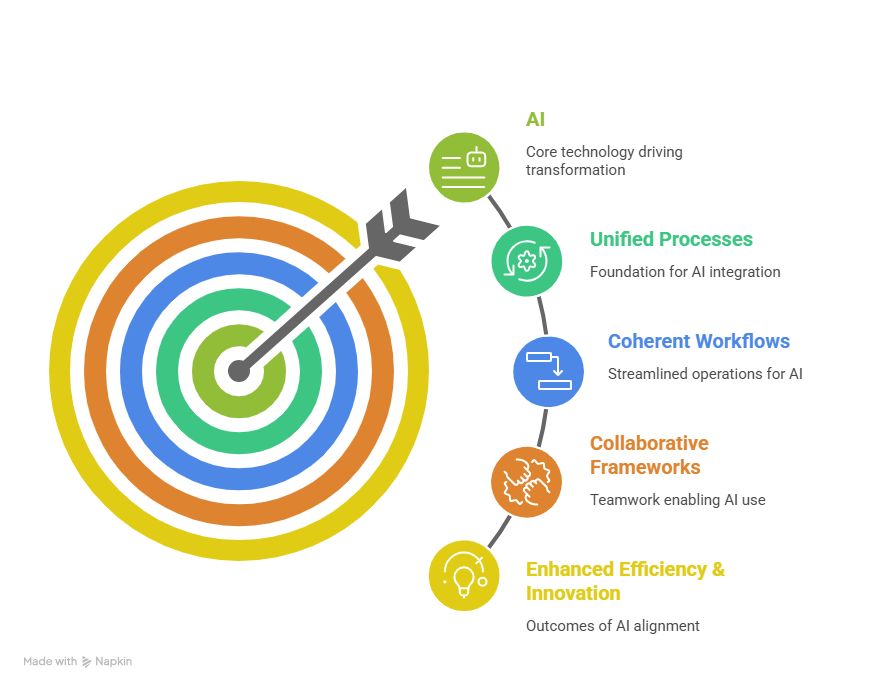
This is why alignment must come before automation.
Why AI Exposes Problems Instead of Solving Them
Most leaders expect AI to create value quickly.
And that expectation is reasonable.
But when processes are misaligned, AI does not bring clarity.
It brings noise.
Misaligned processes do not fail loudly.
They fail quietly.
Conflicting data across systems.
Repeated fixes for the same issues.
Late nights preparing for audits.
Teams doing the right work in the wrong order.
AI does not resolve this.
It makes it visible.
The Reality Inside Most Manufacturing Organizations
In many engineering and manufacturing environments, alignment is assumed.
Everyone believes they are following “the process.”
But in practice:
Engineering defines work one way.
Quality interprets it another.
Operations adapts under pressure.
Compliance verifies after the fact.
Each team is acting with good intent.
Together, they create friction no one owns.
Nothing looks broken in isolation.
But results become unpredictable.
This is where leaders feel it first.
Missed commitments.
Inconsistent reports.
Audits that feel harder every year.
Why Waiting Feels Safe and Why It Isn’t
Most leaders are not wrong for waiting.
Switching systems feels risky.
Alignment feels disruptive.
There is always another program to finish first.
“We can survive another year.”
“We will clean this up later.”
“We cannot slow down right now.”
That hesitation is understandable.
But waiting is not neutral.
Every new project adds variation.
Every workaround becomes precedent.
Every delay increases the size of the eventual fix.
Alignment debt compounds quietly, just like technical debt.
By the time AI is introduced, it is learning from inconsistency.
What Breaks When Alignment Is Missing
Lack of alignment rarely shows up as a process issue.
It shows up as personal pressure.
An engineering manager defending a decision they never approved.
A quality leader rebuilding five years of evidence under audit pressure.
An operations leader explaining why the same issue happened again.
Service issues never feed design.
CAPAs close without preventing recurrence.
Documents drift outside control.
The organization keeps moving.
Risk keeps growing.
This is the moment AI disappoints, not because the technology failed, but because the foundation was never stable.
What Alignment Actually Changes
Alignment is not about control.
It is about clarity.
When teams share one process language, expectations shift.
Tasks follow a consistent structure.
Deliverables are predictable.
Approvals are visible and enforced.
People stop compensating.
They stop double checking.
They stop firefighting.
Work flows.
This is where AI finally delivers real value.
Patterns surface earlier.
Bottlenecks become visible.
Delays are predicted instead of explained.
AI does not replace people.
It removes the friction that holds them back.
Before and After Alignment
Before alignment:
Teams work harder every quarter just to keep up.
Audits feel unpredictable.
Fixes repeat.
Confidence in the data erodes.
After alignment:
Pressure drops.
Decisions make sense.
AI supports the work instead of questioning it.
Audit readiness becomes routine.
This is not just an operational shift.
It is a cultural one.
Fear gives way to confidence.
Blame gives way to visibility.
Reaction gives way to control.
Why Alignment Must Come Before Automation
AI does not create alignment.
It multiplies whatever alignment already exists.
If your processes are inconsistent, AI accelerates confusion.
If your processes are aligned, AI accelerates results.
That is the dividing line.
Automation without alignment increases exposure.
Alignment before automation creates leverage.
The CEO’s Takeaway
Alignment isn’t an operational luxury — it’s a leadership responsibility.
It’s the foundation that lets AI deliver measurable results: faster execution, cleaner data, higher profits, and engaged teams.
At KMD and AIBI, we build the technology and frameworks that make alignment tangible — transforming process chaos into a connected, intelligent system that scales with your organization.
Final Thought
Before you automate, align.
Because when your processes, people, and AI all move in sync, profit becomes predictable — and people start loving their work again.
📈 Want to see how aligned workflows and on-prem AI can transform your teams?
👉 Request a demo and see what’s possible with KMDProjects and AIBI.